| Although the elements of the story are simple and precise, Kubrick infuses a dreamlike quality. Sometimes the characters come alive, other times they seem like so many props for Kubrick's smoldering landscapes and tracking camera movements. The finale, a harrowing cat-and-mouse game with a sniper, ends in a building that -- with its forever-burning (and strategically placed) fires -- looks like a satanic temple. Kubrick's soundtrack is characteristically dynamic and explosive -- whether it's the hardened trudge of soldier's boots , the omnipresent crackle of burning buildings or the prolonged bass note in the final scene that never lets up. Inspired with technique rather than overblown with it, Kubrick, as he is known as the " filmmaker's filmmaker" really "lays it on you". Kubrick began to explore the art of filmmaking in the 1950s. His first films were documentary shorts made possible by his friends and relatives. His first feature, the 1953 military drama Fear and Desire, was made independently of a studio. At that time this was very uncommom. Early into his filmmaking career, Kubrick acted as cinematographer, editor and soundman, in addition to directing. Later on, he would also write and produce. Kubrick made 10 feature films from 1957 to 1998, with early releases including the acclaimed films Spartacus (1960); Lolita (1962), and Dr. Strangelove or: How I Learned to Stop Worrying and Love the Bomb (1964). Kubrick was denied access to military campuses so he went on to construct the sets himself. Kubrick was creative, innovative, and compassionate about his work. A true genius at his art. You could see all elements shine through the films he created. |
Friday, December 19, 2014
Film Review Full Metal Jacket Director Stanley Kubrick

Wednesday, October 22, 2014
Video Fest: The Gold Spinners Documentary Review

The documentary showed how influential film was during that time period to all those people. Watching the commercials helped them feel like their lives were much better than they were.
The film was very interesting and did very well at showing a new perspective to those outside of Russia of something that is very normal here in America.

The Act of Killing Review
The film
focuses on the Indonesian killings of 1965–66,
an ostensibly anti-communist purge in which more than 500,000 people were
killed. When Suharto overthrew Sukarno, the President of Indonesia, following the failed coup
of the 30 September Movement in
1965, the gangsters Anwar
Congo and Adi Zulkadry in Medan (North Sumatra) were promoted from selling black market movie
theatre tickets to leading the most powerful death in North Sumatra. They
also extorted money from ethnic Chinese before
killing them. Anwar is said to have personally killed 1,000 people by methods
such as strangulation with wire.
Today, Anwar is revered as a founding father of the
right-wing paramilitary organization Pemuda Pancasila that grew out of the death squads. The
organization is so powerful that its leaders include government ministers who
are openly involved in corruption, election rigging, and clearing people from
their land for developers, and genocide.
Invited by Oppenheimer, Anwar and his friends recount and
re-enact their experiences and some of their killings for the cameras, and make
dramatic scenes depicting their memories and feelings about the killings. The
scenes are produced in the style of their favorite film genres: gangster,
western, and musical. Various aspects of Anwar and his friends' filmmaking
process are shown, but as they begin to dramatize Anwar's own nightmares, the
fiction scenes begin to take over the film's form, leading the film to become
increasingly surreal. Oppenheimer has called the result "a documentary of
the imagination".
Some of Anwar's friends state that the killings were wrong,
while others worry about the consequences of the story on their public image.
After Anwar plays a victim, he cannot continue. He says
that he feels what his victims have felt. Oppenheimer, from behind the camera,
states that it was worse for the victims because they knew they were going to
be killed, whereas Anwar was only acting. Anwar then expresses doubts over
whether or not he has sinned, tearfully saying he does not want the memories of
what he did to come back to him. He revisits the rooftop where he claims many
of his killings took place, and gags repeatedly. The dancers from the film's
theatrical poster are seen before the credits begin to roll.
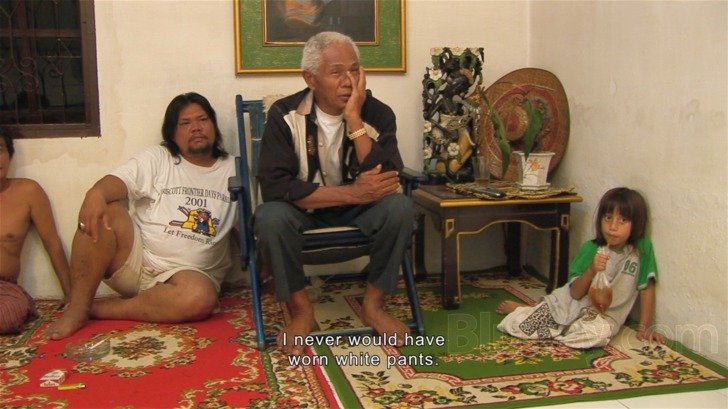
The picture above shows Anwar close to the begining of the documentary, watching himself as he acted out a killing on the rooftop where many others died. He states that he would have never worn white pants, and that he looks like he is going on a picnic. Even though this scene is before where he realizes the wrong he has done, we can still see the sorrow in his face.
This documentary gives a very strong sense of realness, because nothing is held back. Anwar and his friends are not shy to say that they killed happily. They loved it.
Alot of their inspiration came from American ganster films and actors, such as The Godfather and Al Pacino. It was such a great influence that they even dressed like they did and used their methods of killing.
Monday, September 8, 2014
The Kids Are All Right (Lisa Cholodenko, 2010)
Definitions of family, love and friendship all get put to the test with wit and warmth in "The Kids Are All Right." This film takes the idea of family conflicts and shows the strength it has to push through those..
This film combines the many modern elements here -- the sexuality; the breezy California life style; Paul's organic holiness and Peter Pan tendencies -- with a deft mix of insight and cheekiness. And yet when it comes to dramatic moments -- when the fragile family extension falters -- "Kids" is as taut, touching and real as you could ever imagine.
Having a very good plot, ideas, and lessons, it was great, however towards the end was a bit slow and uninteresting.. In contrast to everything that went on before it.
Besides that it was a heart warming film and would recommend it to many.
Subscribe to:
Posts (Atom)